


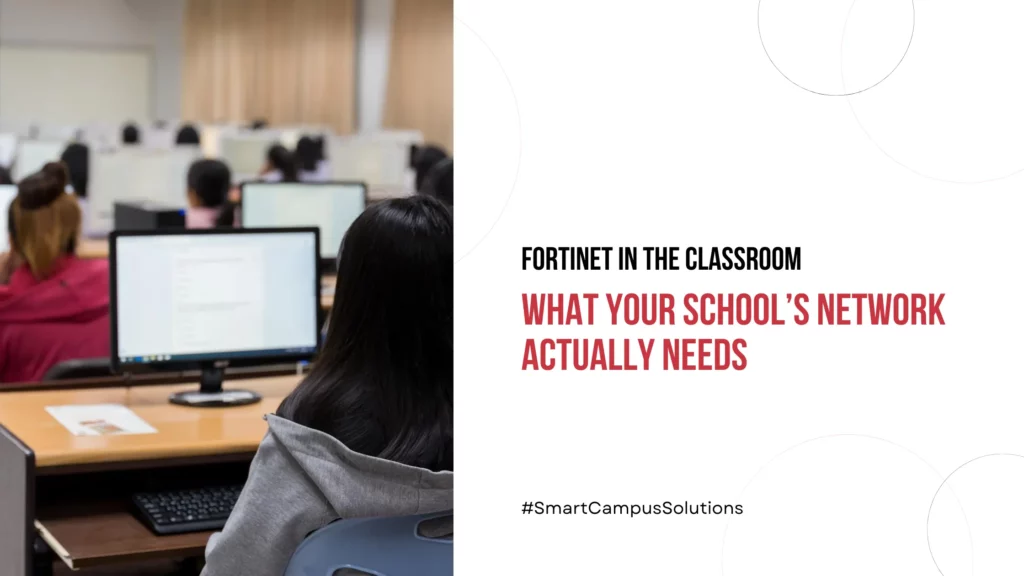
From digital classrooms and online exams to smart attendance systems and CCTV surveillance, today’s schools are deeply dependent on a reliable, secure internet connection. Yet most schools in India are still running outdated routers and unmanaged switches, leaving students exposed to inappropriate content, cyber threats, and sluggish networks that break down during peak hours.
Fortinet is one of the world’s leading cybersecurity and networking companies, trusted by thousands of educational institutions globally. With a tightly integrated ecosystem of firewalls, wireless access points, switches, and cloud management tools, Fortinet offers everything a school needs under one roof. Let’s break it all down.
What Schools Look for in an Internet & Network Solution
School administrators, IT teams, and management need to be clear about what actually matters when investing in networking infrastructure. The first priority is content filtering and student safety. Schools must block adult content, gambling sites, social media distractions, and other harmful material from student devices. Close behind is reliable, high-speed connectivity. Buffering during an online class or a slow connection during an exam is unacceptable, so the network has to handle hundreds of concurrent users without dropping.
Security against cyber threats is just as important. Schools are increasingly targeted by ransomware and data theft, which makes a robust firewall that detects and stops threats in real time non-negotiable. Then there’s ease of management. IT staff at most schools are limited, so the solution must be easy to configure, monitor, and troubleshoot, or it should be outsourced to an external IT partner. Scalability matters too, because whether it’s 200 students or 2,000, the infrastructure should grow without a complete overhaul.
Finally, schools operate on tight budgets, so affordability and long-term value count. A solution that bundles security, switching, and Wi-Fi in one ecosystem reduces the total cost of ownership. Schools also need compliance and reporting, with logs and reports that demonstrate safe internet use to management, parents, and regulatory bodies.
Fortinet's Key Products for Schools
FortiGate Next-Generation Firewall (NGFW)
The FortiGate is the heart of any Fortinet deployment. It’s not just a firewall, it’s a full-featured network security platform that combines intrusion prevention, application control, VPN, SD-WAN, and deep content filtering in a single device. For schools, the FortiGate 40F and 60F are ideal entry points. The 40F suits smaller schools with up to 150 to 200 concurrent users, while the 60F comfortably handles medium-sized campuses. Larger schools or multi-campus setups can look at the FortiGate 80F, 100F, or 101F.
In practice, FortiGate blocks inappropriate websites using FortiGuard content filtering categories, which can be configured through age-appropriate profiles with different rules for junior school, senior school, and staff. It detects and blocks malware, ransomware, and phishing attacks in real time, and it controls which apps students can use, so gaming, streaming, or peer-to-peer apps can be blocked during school hours. It also manages bandwidth so exam portals and learning platforms always get priority, and it provides secure VPN access for remote learning.
On pricing in India, the FortiGate 40F runs about ₹28,000 to ₹35,000 for hardware only, and ₹55,000 to ₹65,000 with a 1-year UTM bundle license. The FortiGate 60F with a 3-year UTM bundle license comes to roughly ₹1,00,000 to ₹1,30,000, while the FortiGate 80F with a 3-year bundle sits between ₹1,80,000 and ₹2,50,000. These are indicative market rates from Indian authorised resellers, and actual pricing varies by partner and subscription tier.
FortiAP Wireless Access Points
No school network is complete without solid Wi-Fi. FortiAP access points are managed directly through the FortiGate firewall, so there’s no need for a separate wireless controller, which simplifies deployment and reduces cost. For classrooms, corridors, libraries, and labs, the FortiAP 231F and 431F are popular choices, while outdoor areas like sports grounds and parking zones can be covered with the outdoor-rated FortiAP 433F.
These access points provide high-density Wi-Fi 6 connectivity, which is ideal for classrooms where 30 to 40 devices connect at once. Since every unit is managed centrally from FortiGate, IT staff can push policies, monitor usage, and troubleshoot from a single screen. The same content filtering policies automatically apply over Wi-Fi, so students can’t bypass filters just by switching to wireless. Guest Wi-Fi can be isolated from the school’s internal network in one click, and FortiPresence analytics let schools see heatmaps of where students use Wi-Fi the most.
For pricing in India, the FortiAP 231F (indoor, Wi-Fi 6) costs about ₹18,000 to ₹25,000 per unit. The FortiAP 431F (indoor, high-density Wi-Fi 6) is ₹35,000 to ₹45,000 per unit, and the outdoor FortiAP 433F is ₹45,000 to ₹60,000 per unit.
FortiSwitch Ethernet Switches
FortiSwitch provides the wired backbone of the school network, connecting classrooms, labs, servers, and IP cameras to the main network. Like FortiAP, it’s managed directly through FortiGate via FortiLink, giving IT teams unified control over the entire network from one interface. Schools typically need PoE (Power over Ethernet) switches to power IP phones, access points, and cameras without running separate power cables. The FortiSwitch 108F-POE (8 ports) is ideal for small rooms or server closets, while the FortiSwitch 148F-FPOE (48 ports with full PoE) suits larger campuses.
FortiSwitch connects all wired devices like PCs, smart boards, cameras, and APs at Gigabit speeds, and PoE models remove the need for separate power adapters. VLAN segmentation keeps student traffic, staff traffic, and administrative systems on separate logical networks, so if one is compromised, the others stay safe. Zero-touch provisioning also means new switches can be deployed and configured remotely with minimal IT effort.
On pricing in India, the FortiSwitch 108F-POE (8-port with PoE) costs ₹22,000 to ₹30,000, the 124F-POE (24-port with PoE) costs ₹55,000 to ₹75,000, and the 148F-FPOE (48-port full PoE) costs ₹1,00,000 to ₹1,30,000.
Note:- All prices are indicative estimates and may change based on reseller pricing, licensing plans, and product availability.
FortiClient & FortiClient EMS
FortiClient is an endpoint security agent installed on student and staff laptops or school-managed devices. It extends FortiGate’s content filtering policies to devices that are taken home, so the same safe-browsing rules apply whether a student is on school Wi-Fi or home broadband. FortiClient EMS (Endpoint Management Server) lets IT centrally manage and push policies to all FortiClient-installed devices across the school, saving hours of manual configuration.
FortiCloud & FortiManager
For schools that prefer cloud-based management, FortiCloud provides a zero-touch deployment and central management platform. FortiManager is the on-premise alternative for larger districts or multi-campus setups managing many FortiGate firewalls, switches, and APs from a single dashboard.
FortiGuard AI-Powered Security Services
All Fortinet products are supercharged by FortiGuard, Fortinet‘s global threat intelligence service powered by AI. It continuously updates FortiGate with the latest threat signatures, malicious IPs, and web filtering categories. For schools, FortiGuard’s content filtering database includes age-appropriate categories that can be applied to student and staff profiles with a few clicks. Fortinet also offers a free Security Awareness and Training service for primary and secondary schools worldwide, giving students and teachers access to cybersecurity education at no additional cost.
A Typical Fortinet Setup for a Medium-Sized School (500 to 800 Students)
A school of this size might deploy a single FortiGate 80F as the central firewall and network controller. Around 8 to 12 FortiAP 231F units would cover all classrooms, the library, and common areas, while 3 to 4 FortiSwitch 148F-FPOE units would connect wired devices and power the APs. A FortiGuard UTM license handles real-time threat protection and content filtering, and FortiCloud takes care of remote monitoring and management.
The estimated total investment is ₹6,00,000 to ₹10,00,000 (hardware plus 3-year licenses), depending on reseller pricing and campus size. That works out to roughly ₹1,500 to ₹2,500 per student over three years, a very reasonable price for a complete, enterprise-grade secure network.
Why Fortinet Stands Out for Indian Schools
Unlike generic networking gear, Fortinet’s tightly integrated Security Fabric means every device’s firewall, switch, and access point talks to each other. A threat spotted at the firewall instantly informs the switches and endpoints, triggering an automated response across the entire network. This convergence of networking and security, managed through a single pane of glass, drastically reduces the burden on school IT staff.
For schools in India navigating limited IT budgets and growing cybersecurity risks, Fortinet offers one of the best cost-to-protection ratios in the industry. It’s the kind of investment that pays for itself the moment it stops a ransomware attack from encrypting your exam records.
Frequently Asked Questions
Fortinet firewalls protect school networks from cyber threats, block harmful websites, filter content, and provide secure internet access for students and staff.
No. Fortinet is the company, while FortiGate is its next-generation firewall product designed to secure networks.
It helps schools filter internet traffic, restrict inappropriate content, prevent cyberattacks, and protect sensitive student and staff data.
A good school firewall should offer content filtering, intrusion prevention, malware protection, application control, bandwidth management, and centralized monitoring.
FortiAP 231F and 431F are suitable for indoor school environments, while FortiAP 433F is designed for outdoor connectivity.


 1st Floor, H-31, Sector 63,

 +91 7898375456