


As a school administrator or principal, you have likely witnessed the chaotic domino effect of a sudden network outage. A teacher is midway through an interactive digital lesson, or a high-stakes online assessment is underway, and suddenly everything grinds to a halt.
When digital tools form the backbone of modern pedagogy, a dropped internet connection is not just an inconvenience. It represents lost learning hours and operational paralysis. Choosing the right ISP for school requires looking at deep architectural factors that happen behind the scenes.
Why speed alone is a misleading metric
Home-grade internet connections are built on a best-effort model. The bandwidth is shared with thousands of neighbours, and performance fluctuates based on peak usage times. For an institution managing hundreds or thousands of simultaneous device connections, ranging from student laptops to smart boards, this model quickly breaks down.
To understand why two identical speed profiles perform differently, we have to look at how these providers actually build their networks.
The Core Backbone Network
An internet provider’s backbone is the principal data route managing its network traffic. Large, established enterprise providers own and operate their own subsea cables, long-distance fiber networks, and massive data centers.
Why it matters?
When comparing ISPs for school implementation, providers with a robust, self-owned backbone can route your data more efficiently. This results in significantly lower latency, which is the delay between sending and receiving data, ensuring smooth video conferencing and real-time digital learning.
Infrastructure Redundancy and Upstream Carriers
Data does not travel in a straight, isolated line. It passes through various exchange points managed by upstream carriers.
Why it matters?
High-tier providers maintain relationships with multiple upstream carriers and build diverse physical fiber paths. If a local construction crew accidentally cuts an underground fiber line down the street, robust ISPs for school use can instantly and automatically reroute your data through an alternate path without you ever realizing there was a break.
Service Level Agreements (SLAs) and Fault Resolution
When a residential internet connection goes down, customer support typically operates on a generic, multi-day queue. Educational campuses cannot afford this layout.
Why it matters?
Dedicated enterprise ISPs for school customers come with a legally binding SLA. This document guarantees a specific uptime percentage, often 99.5% or higher, and defines a strict fault resolution time. This is a guarantee that engineers will be actively resolving a physical network failure within 2 to 4 hours.
The strategic importance of location
In the enterprise space, there is no single best internet provider that dominates every region. In India, major players like Airtel Business, Tata Tele Business Services (TTBS), Jio Business, ACT Business, and BSNL Enterprise all possess massive networks.
However, the final selection among various ISPs for school deployment should always depend entirely on local fiber infrastructure. A provider might have an incredible national reputation, but if they do not have a strong, physically mature fiber ring laid down in your specific neighborhood, your connection will suffer from frequent localized disruptions. The quality of the last-mile connection, meaning the physical cable coming from the street into your server room, is the ultimate bottleneck.
The recommended architecture: Dual-ISP with Intelligent Failover
Even the most robust single internet line is vulnerable to catastrophic events like extreme weather, major grid failures, or severe physical cable cuts.For modern educational environments where continuous connectivity is non-negotiable, the gold standard is implementing a dual-provider network design using two independent enterprise connections for school continuity.
Instead of relying on a single link, the campus utilizes two independent enterprise connections routed into a central, smart firewall.
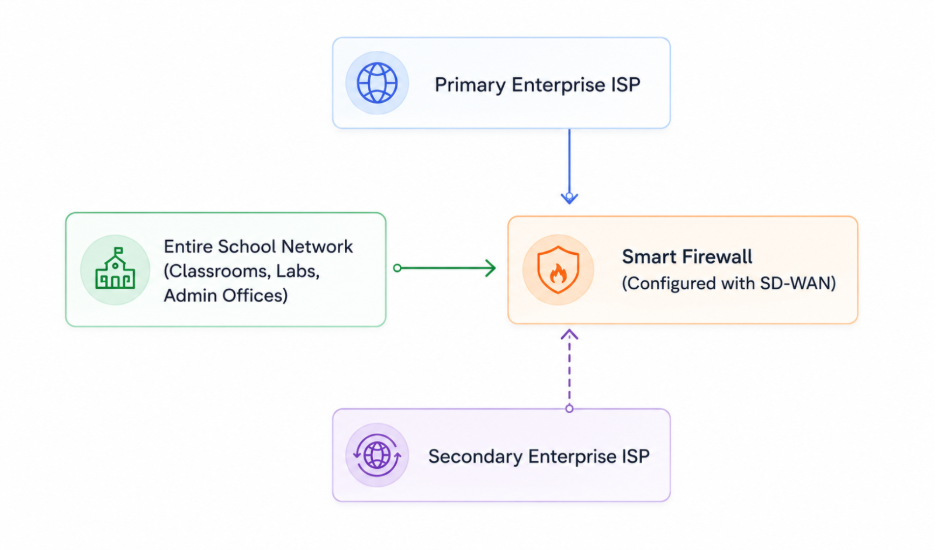
By configuring the firewall with SD-WAN (Software-Defined Wide Area Network) or automatic failover, the system continuously monitors the health of both lines. The moment the primary connection drops or experiences severe lag, the firewall transparently shifts all campus internet traffic to the secondary provider within milliseconds.
The rule of absolute independence
The most critical mistake a campus can make when designing a dual-provider system is failing to ensure true path diversity. Your backup internet link is only effective if it avoids the same points of failure as your primary link.
When choosing a secondary provider, verify that it:
- Does not lease or share the exact same physical underground conduits or utility poles as your primary provider
- Does not rely on the same upstream carrier or regional exchange point
If both of your providers rely on the exact same local physical infrastructure, a single accidental trench dig down the main road will take down both your primary line and your backup simultaneously.
Summary
Investing in a digital infrastructure requires looking far beyond the price tag or a basic speed test. When evaluating various ISPs for school upgrades for the upcoming academic cycles, prioritize providers that demonstrate a transparent local fiber map, clear enterprise-grade SLAs, and a willingness to provide dedicated support. Coupling a strong primary line with a genuinely independent secondary line is the single most effective way to guarantee an uninterrupted environment for modern teaching and learning.
Not sure if your current setup can handle a failure like this? Netoyed can audit your campus network and help you design a dual-ISP setup built for real reliability. Get in touch to get started.


 1st Floor, H-31, Sector 63,
 +91 7898375456