


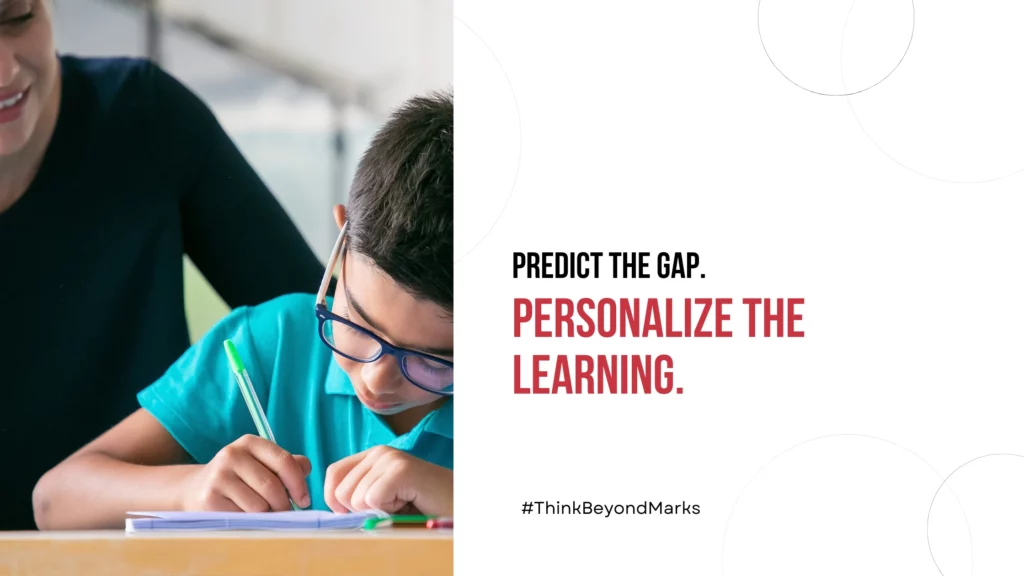
Every school wants to catch a struggling student early. But catching the problem and actually solving it are two very different things, and most schools stop at the first one.
Personalized Learning is what happens after a gap has been spotted. It’s the part where a school stops treating every student the same way and starts asking a harder question: what does this specific student actually need to close the gap?
Two students stuck on the same topic might need completely different fixes. One might just need more repetition. Another understands the concept fine but struggles with how it’s tested. A third grasps it instantly through video but checks out during a written explanation. Treating all three the same way, more homework, extra classes, the standard remedial routine, misses the point entirely.
Flagging Tells You Where.
Personalization Tells You How.
Predictive analysis is good at pointing at a gap. It can tell you a student is falling behind in algebra, or that their engagement has dropped in a specific subject. What it doesn’t automatically solve is how that student should be taught differently to close that gap.
That’s a separate problem, and it’s a teaching problem, not just a data problem. Two students flagged for the same weak topic might need completely different fixes. One might just need more repetition. Another might understand the concept fine but struggle with how it’s being tested. A third might grasp it instantly through a video but completely check out during a written explanation.
This is exactly why treating every flagged student the same way, more homework, extra classes, the standard remedial routine, doesn’t always work. The flag tells you there’s a problem. Personalized learning is what actually addresses it, because it starts from the idea that students don’t all absorb information the same way.
What Personalized Learning Looks Like When It’s Actually Working?
We’ve seen this play out in a school that had shifted its classrooms to a fully device-based setup, laptops and tablets for every student, and rebuilt how homework worked around it.
Instead of every student getting the same worksheet, the same format, due the same way, students were given a choice in how they completed an assignment. Some picked multiple-choice style questions because that’s how they process information best. Others preferred writing out longer, detailed answers. A few consistently chose to submit video explanations of what they’d learned instead of writing anything at all.
Same homework, same learning objective, three completely different formats. And that’s really the whole idea behind personalized learning. It isn’t about lowering the bar or making things easier. It’s about accepting that a one-size-fits-all worksheet was never actually fitting everyone in the first place. A student who understands a concept deeply but freezes at essay-style questions isn’t less capable, they just need a different format to show what they know.
Where Data Analytics Comes Back Into the Picture
Here’s where the two ideas connect properly. Predictive analysis flags the problem at the start. Personalized learning becomes the intervention. Data analytics is what tells you whether the intervention actually worked.
Once a school adopts a personalized approach, format choice, pace flexibility, different content types, the teacher isn’t just guessing whether it’s helping. The same data analytics tools that flagged the original weak spot can now track that same student’s performance after the change. Are the scores improving on that specific topic? Is the student re-engaging in a subject they’d checked out of? Is the gap that predictive analysis originally caught actually closing, or does the approach need to shift again?
This turns data analytics into a full loop instead of a one-time alert. Flag the issue, personalize the response, measure the outcome, and adjust if needed. It’s continuous, not a single report generated once a term. A teacher isn’t relying on the next exam to find out if the intervention worked. They can see it building, or not, in real time.
What This Requires From a School?
None of this works without students actually having consistent access to devices and a platform that can capture this kind of data cleanly. A personalized, choice-based homework model only functions if every student has a laptop or tablet that works reliably, a network that can support a full class submitting different formats at once, and a system that’s actually tracking submissions and scores in a way teachers can read at a glance.
This is really the infrastructure layer underneath the whole idea. Schools can have the right intent, wanting to personalize learning and use data to track progress, but without dependable devices, connectivity, and a properly set up learning management system, it stays a good idea on paper. The tech has to be solid enough that teachers can focus on interpreting the data and adjusting their teaching, instead of troubleshooting why half the class can’t submit their video assignment.
Closing the Loop
Predictive analysis tells a school where to look. Personalized learning gives students room to actually close that gap in a way that works for how they learn. And data analytics ties it together by showing, clearly and continuously, whether that gap is actually shrinking.
None of these three pieces work particularly well in isolation. Together, they turn a school’s approach to student performance from reactive, waiting for the report card, into something that’s genuinely responsive throughout the year.
At Netoyed for Education, we help schools build exactly this kind of setup, from the devices and network infrastructure to the data systems that make predictive analysis and personalized learning actually usable day to day. We’ve worked with schools moving toward smarter, more responsive classrooms, and seen firsthand what it takes to make the shift stick.
If your school wants to move from flagging problems to actually solving them, and measuring whether it’s working, let’s talk about how to set that up.


 1st Floor, H-31, Sector 63,
 +91 7898375456