
It’s not new to use AI in schools. Students have been using it for a long time for things like homework, research, and notes, and a lot of the time their teachers or parents don’t even know. A lot of schools had strict no-AI rules, but students still used it.
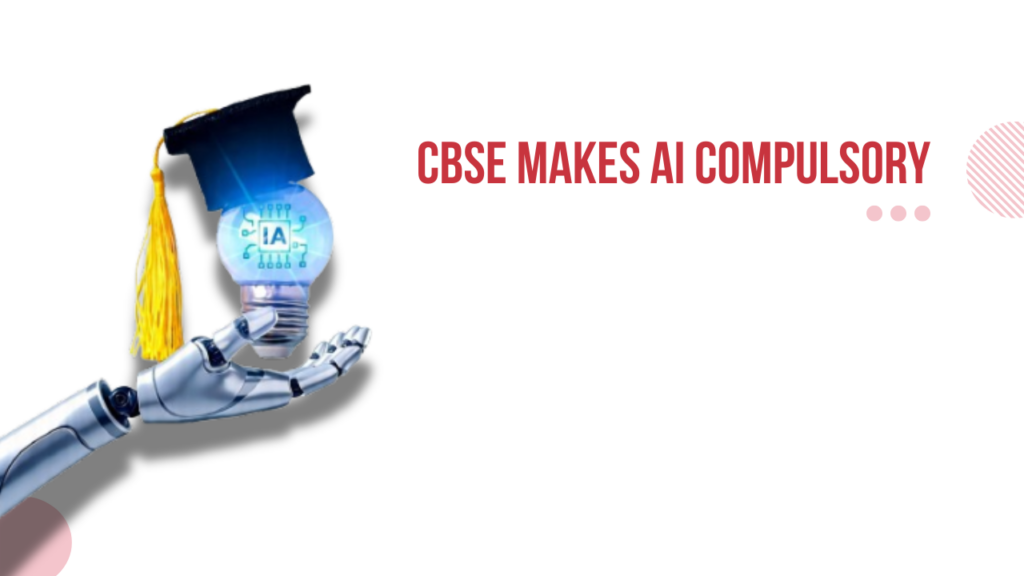
But in April 2026, CBSE stopped fighting the tide and made AI required in all its schools. This is what that order really means.
AI: Banned to CBSE-Mandated
The Central Board of Secondary Education has introduced a major shift to India’s education system by officially adding Computational Thinking and Artificial Intelligence to regular classrooms. This shift was launched by Union Education Minister Dharmendra Pradhan along with an expert panel from IIT Madras on April 1, 2026, for students in Classes 3 to 8 in compliance with the National Education Policy 2020.
This is a big shift in how schools across the country will teach students. Starting in the 2026-27 school year, every CBSE student will learn about logical thinking, problem-solving, and basic AI concepts every day.
AI for students and its impact
The curriculum is meant to do more than just teach coding. Students will learn how to think logically, solve problems, recognize patterns, understand data, basic AI concepts, and how to use technology in a way that is morally right, depending on their grade level.
- For students in Classes 3 to 5, learning will be based on activities and will be integrated into subjects they already study, such as Maths, Language, and EVS. There will be more emphasis on projects and paper-based tasks than on screen time. The plan is to teach the brain first and then give the tool.
- Classes 6 to 8 go even further by teaching students what AI is, how it works, and where they can see it in their daily lives. This is done in a collaborative way across different subjects instead of in isolation.
- From grades 9 to 12, the focus gets more serious. Computer Science teachers lead dedicated AI lessons, and advanced computational thinking is built into the curriculum.
* AI will also be a full board-examined subject starting in 2029, making it as official as any other core subject. *
Empowering Teachers for the AI Classroom
CBSE isn’t just giving teachers a new curriculum and telling them to figure it out on their own. The main focus of training for teachers in 2026–27 will be AI and Computational Thinking. There will be training through district workshops, school-level activities, expert-led sessions, and regional programs at CBSE Centres of Excellence. These will cover seven main areas, including pedagogy, real-world AI applications, and assessment strategies.
Challenges That CBSE Schools Are Facing
There are more than 27,000 CBSE-affiliated schools in India. This order affects all of them. But about half of Indian schools still don’t have basic digital infrastructure. The internet isn’t reliable. No computers. Sometimes there is no power. The mandate is real, but the situation on the ground is not the same everywhere.
And then there’s the problem of not enough teachers. More than 1 crore of teachers need to be trained to teach this curriculum well. The NISHTHA program on the DIKSHA platform is where CBSE is giving training. But training on that scale takes time, and the school year has already started.
What Schools Need to Do Right Now
Infrastructure Audit: Schools cannot teach AI without the basics in place. Internet connectivity, devices, and functional computer labs are non-negotiable.
Teacher Orientation: Schools should not wait for official training and start exploring CBSE’s free SOAR (Skilling for AI Readiness) modules which are already used voluntarily in 18,000+ schools. It’s a strong starting point.
Rethinking Assessment: Multiple choice questions won’t cut it for AI education. Think projects, case studies, prototypes. Students should demonstrate thinking, not just recall.
Treat it as a mindset shift, not a subject addition: The goal isn’t to produce coders. It’s to produce critical thinkers who understand the world they’re growing up in.
What No One Is Telling Parents About AI
Your child is going to encounter AI concepts in school whether you fully understand them or not and that’s okay. The best thing you can do is stay curious alongside them. Ask what they’re learning. Let them explain it to you. You might be surprised by how much they pick up, and how quickly. If your child’s school hasn’t communicated anything about this change yet, that’s worth following up on. This isn’t a minor syllabus tweak but a fundamental shift in how your child will be educated.
The Bottom Line
India is making a bold bet, that is introducing AI early, at scale, and across all socioeconomic backgrounds will create a generation that doesn’t just use technology but understands it.
It’s the right bet. But a mandate on paper only becomes a movement in practice.
The schools that take this seriously today and that invest in infrastructure, train their teachers, and build genuine AI literacy will produce students who are genuinely ready for the world ahead.
The ones that don’t will just produce students who know the definition of machine learning.
There’s a big difference.


 1st Floor, H-31, Sector 63,
 +91 7898375456