
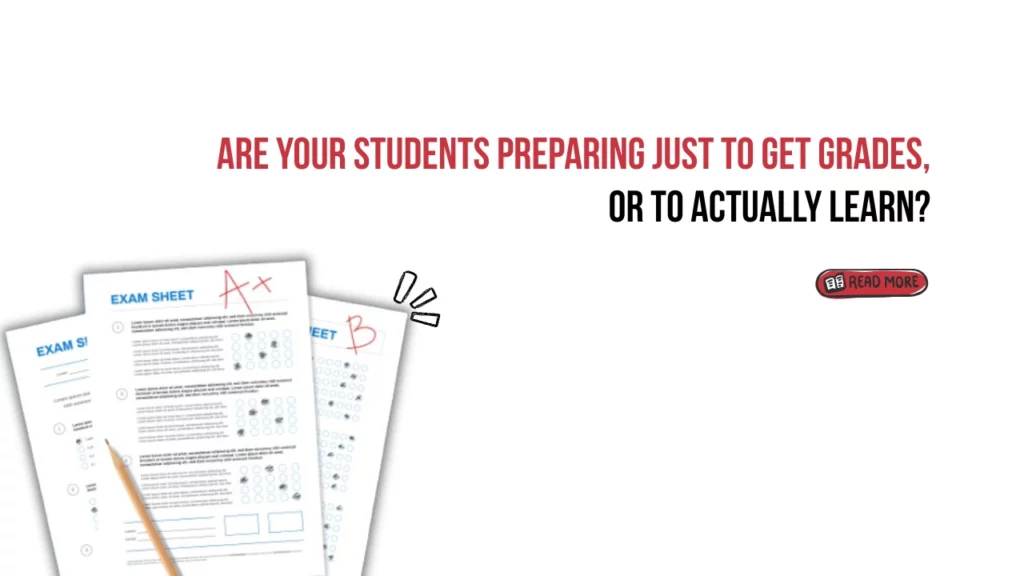
Most schools still rely on a traditional feedback loop where the teacher acts as the sole judge of the progress. In this model, students often wait for a grade that tells them what they did wrong after the lesson has already moved on.
This creates a culture of passive learning, where students focus on “getting the grades” rather than understanding their own growth. When learners rely entirely on external validation, they struggle to identify their own mistakes or take initiative when the work gets tough.
This gap in the learning process leaves school leaders with a difficult question: How do we move beyond a system that merely records achievement to one that drives improvement?
Turning self-evaluation into a learning tool
Once you identify the problem of passive learning, the focus must shift to how reflection actively bridges the gap between completing a task and truly mastering a subject.
By introducing self-evaluation for students into the daily routine, the dynamics of the classroom shift towards understanding the process. This encourages students to look at the ‘how‘ and ‘why’ of their work without getting anxious about results.
When a student reviews their own progress, they start to identify personal learning patterns. They find certain mathematical concepts easier to grasp when they are presented visually or feel more comfortable writing after brainstorming out loud.
This level of self-awareness is difficult to teach through a lecture; it must be experienced through regular, guided reflection.
How teachers can guide students through self-reflection
To make reflection effective, teachers should provide clear and simple criteria. If a student tries to judge their work without any guidance, they often feel overwhelmed.
As a teacher, you can provide targeted questions to help focus their attention and keep the process manageable.
Using peer feedback as a bridge
Sometimes, looking at your own work is the hardest place to start. Peer review serves as a helpful first step. By checking a classmate’s work against a rubric, students learn to spot strengths and weaknesses without the emotional attachment they usually feel toward their own writing.
Once they practice this on someone else’s work, they can more easily apply that same logic to their own efforts.
Creating a safe environment for honesty
For Self-evaluation for students to work, learners must feel safe to admit what they do not understand. If they fear that honesty will lead to a lower grade, they will hide their difficulties.
Teachers can prevent this by separating the act of reflection from the final mark. When the focus stays on the process of learning rather than a perfect output, students become much more open to genuine self-critique.
The benefits of self-evaluation for students
The habits students form through regular reflection stay with them long after they leave school. When a student learns to assess their own work, they gain the independence needed to navigate their future with confidence.
- Building a growth mindset: Regular self-evaluation for students reinforces the idea that effort improves intelligence. Learners begin to embrace challenges and stay resilient, seeing mistakes as chances to grow rather than failures.
- Driving internal motivation: Self-assessment shifts the focus from chasing grades to finding personal satisfaction. When students see value in their work, they engage because they find the task meaningful.
- Improving self-regulation: This process teaches students to monitor their own thoughts and actions. They learn to plan their time well, handle stress better, and fix mistakes as they go.
- Sharpening self-reflection: Thinking critically helps students spot their own strengths and weaknesses. These learners understand how they work best, allowing them to set clear goals and apply their knowledge to new situations.
Consistent reflection helps students reach their life goals. This approach ensures every learner leaves the classroom understanding their potential and possessing the skills to reach it.
Overcoming common challenges in self-evaluation
While self-assessment is powerful, it isn’t always perfect. Teachers should keep a few things in mind:
- Inconsistent marking: A student’s view of their work might differ from a peer’s or a teacher’s. Use these differences as a talking point rather than a “wrong” answer.
- Confidence levels: Students with low self-confidence often under-rate their work, while others might over-rate it. Frequent practice helps them find a realistic middle ground.
- Emotional state: How a student feels on a particular day affects their reflection. Encourage them to focus on the evidence in their work rather than their mood at the time.
Building a path toward autonomy
Implementing these strategies requires a fundamental shift in how we view the classroom hierarchy. Moving away from a teacher-led model toward one centered on self-evaluation for students.
By providing clear frameworks, and addressing the emotional hurdles of self-assessment, schools can create an environment where learners take full ownership of their journey. When we normalize reflection, we stop being mere collectors of data and start becoming true facilitators of growth.
As Carl Rogers famously noted, “The only person who is educated is the one who has learned how to learn and change.”


 1st Floor, H-31, Sector 63,
 +91 7898375456